
🏒 Mitten Memories: How I Became a Red Wings Fan — The Glory of Growing Up Through the Pain
Watching the Struggles, Remembering the Spark
I was watching the Wings vs. Blackhawks game this weekend, and it wasn’t going well. The team has been mired in a scoring slump, which got me thinking about bad hockey — the kind of hockey that makes you wonder why you’re still watching. My mind started wandering back to where it all began, and how I became a Red Wings fan.
It started back in 1977. Before that season, they were bad — really bad. We’re talking about the days of the Old Red Barn, Olympia Stadium, when Montreal came into town and seemed to score at will. The Canadiens owned us, the scoreboard tilted against Detroit most nights, and yet I couldn’t stop watching. I was in junior high, falling in love with a sport that was on the fringe of the mainstream, which made it all the more appealing.
Lots of fights on the ice. Characters in the penalty box. Players without helmets, risking their lives to stop a shot from the point.
The Season that Pulled Me In
As bad as the Wings had been in the mid-’70s, the 1977–78 Detroit Red Wings felt different. They were far from a powerhouse, but for many fans of that era, that season felt like the first real light after years in the dark.
Under coach Bobby Kromm, Detroit finished 32–34–14 and finally clawed its way back into the postseason for the first time since 1970.
I’ll never forget watching Bill Lochead score the game-winning goal against the Atlanta Flames to give the Wings a 2-0 series victory — Detroit’s first playoff series win in nearly a decade. It would be several years before they returned to the postseason, but that moment lit a spark that never went out.
Hockey Was Wild and Loyalty Was Earned
There was something about that era — without all the distractions of today — that allowed kids to form special bonds with their hometown teams. We didn’t have PlayStations or iPhones. All we had were a few TV stations, a radio, and maybe a stack of records to keep us company at night.
Back then, the NHL had just eighteen teams, each with a roster I knew from top to bottom. The Wings were a group of journeymen, and on most nights, you knew what the outcome would be — but I watched or listened anyway. You may recall that back then, the game was broadcast on either TV or radio, but never both at once.
Most nights, my transistor radio was tuned to WWJ 950 AM, where Bruce Martyn and Sid Abel brought the game to life. To this day, I’ll argue Martyn was the best play-by-play announcer to ever call a hockey game.
I was just a kid who loved those teams and made sure I was near a radio or TV whenever they played
The Faces You Couldn’t Forget
In the 1970s, hockey wasn’t far from the movie Slapshot. On many nights, gloves were scattered all over the ice. There were guys in the league whose only job was to fight — and we loved every second of it. Fans cheered for blood, and every once in a while, Dennis Polonich or Dan Maloney gave us a show.
Dale McCourt was the bright spot — young, skilled, and one of the few who could consistently score, averaging in the high 20s. Fans still remember his 1978 lawsuit after Detroit acquired Rogie Vachon from Los Angeles; McCourt didn’t want to leave the Wings, and his loyalty endeared him to the city.
Reed Larson was a personal favorite — known for the hardest slapshot in the NHL — and Václav Nedomanský, the Czech import, brought much-needed flair to a team desperate for it.
And who could forget Jimmy Rutherford, the Red Wings goalie with what I still swear was the coolest mask in hockey.
They played in the Norris Division, battling Montreal, Pittsburgh, Washington, and Los Angeles. That 1977–78 squad finished second behind the mighty Canadiens — not bad for a team that had been buried for years.
The Barn That Built the Fan
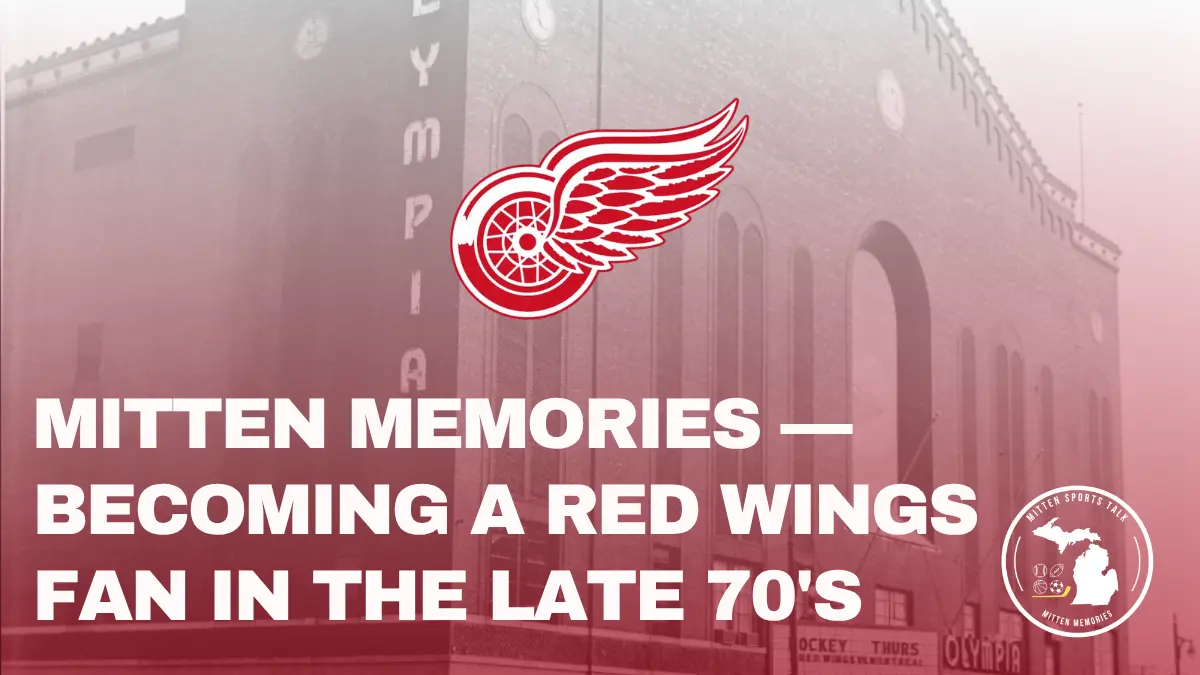
If there was one place that defined those years, it was Olympia Stadium — the Big Red Barn.
The narrow concourses. The seats jammed shoulder-to-shoulder. The escalators so steep you felt like you might fall backward. If you were up high, it felt like you were hanging over the ice. You could hear the boards rattle and the skates bite — it was raw hockey in its purest form.
I’ll never forget being there for the final game before the Wings moved downtown to Joe Louis Arena — a 4-4 tie against the Quebec Nordiques. I was heartbroken to see the Wings leave the Red Barn, and it took years for the Joe to feel like home
From the Bottom of the Standings to the Top of the World
Fast-forward a couple of decades. I got married the same night the Red Wings beat the Flyers to win the Stanley Cup in 1997.
Think about that — the kid who sat through those brutal late-’70s seasons was tying the knot the night Detroit finally lifted the Cup. That night wasn’t just about love and vows — it was about redemption. For all of us who suffered through the lean years, that Cup felt like a reward decades in the making.
Why It Still Matters
Fans who grew up during that late-’70s, early-’80s chaos — before Yzerman — earned their fandom. We didn’t stay for the wins; we stayed because the Wings were ours.
We stuck it out through empty seats, losing streaks, and lousy rosters. We watched the fights, cheered the few goals, and believed anyway.
When Stevie Y arrived, we were ready. We’d been trained by heartbreak. We knew how sweet winning could be because we’d lived through every kind of loss imaginable.
Final Thought
Those were the days — the vertical escalators at Olympia, the smell of popcorn, the Winged Wheel, Bruce Martyn and Sid Abel’s calls echoing through the static. That’s what I remember most.
Oh, and also the night my grandfather’s car got stolen right across the street from the arena. What memories.
What about you? Were you around for those Big Red Barn years? Did you endure those Montreal beatdowns and love every minute of it? Drop your story below — the Red Wings Wheelhouse is open for memories from the faithful who never gave up on the Winged Wheel.
Feature Image of Olympia Statium Courtesly of: G.G. from Hoxie, Kansas, USA, CC BY 2.0 https://creativecommons.org/licenses/by/2.0, via Wikimedia Commons